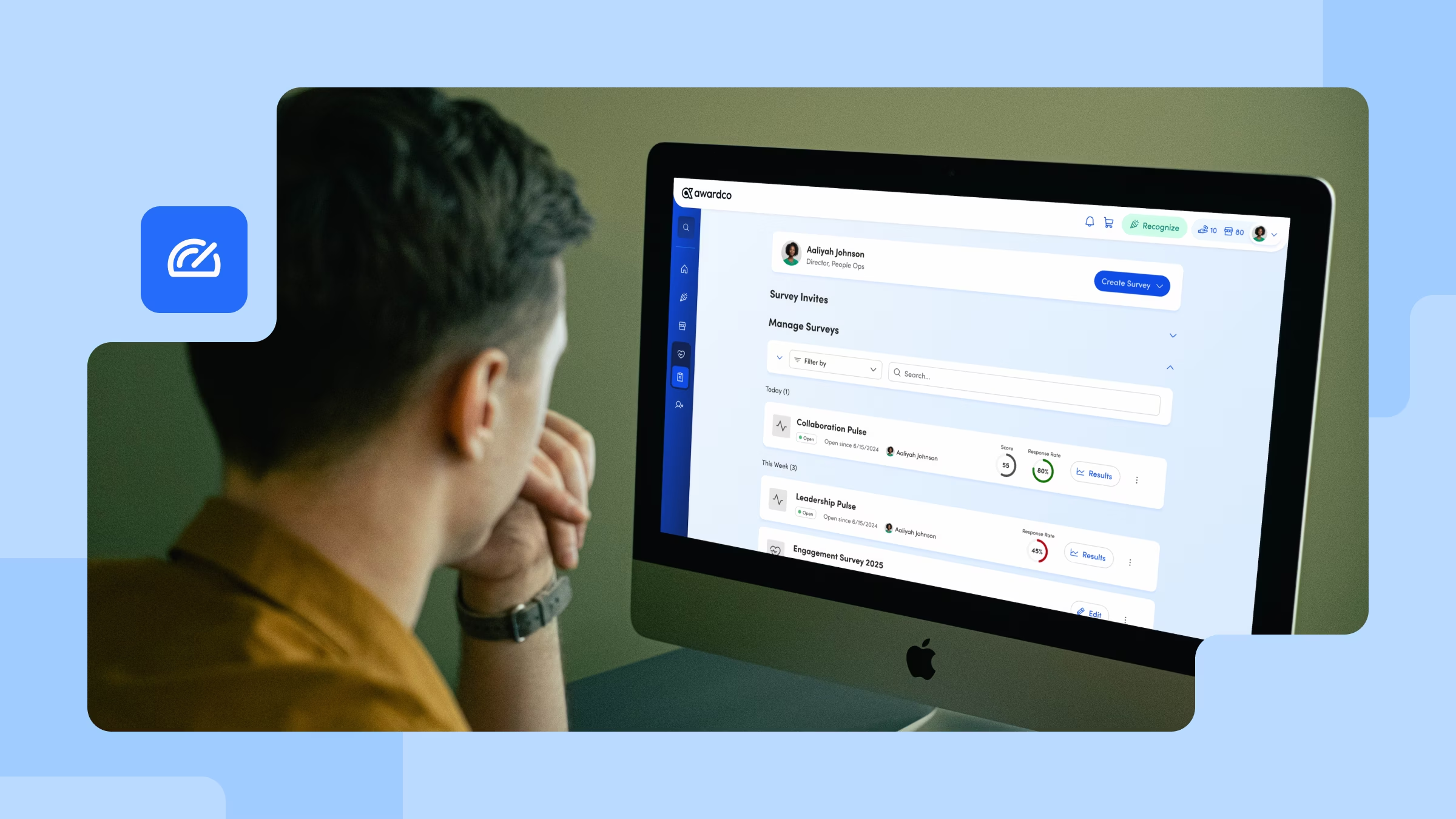

Employee engagement platform buyer’s guide: how to choose the right solution
An employee engagement platform helps organizations gather employee feedback, understand engagement over time, and turn insights into meaningful action. For enterprise buyers, the evaluation also has to cover integration depth, global governance, security, access, budgets, implementation, and the connection between listening and recognition.
The right platform for a large organization supports customizable surveys, manager action planning, deep analytics, recognition integration, global governance, HRIS synchronization, frontline access, budget controls, implementation support, and enterprise security. This guide gives you a 10-feature checklist, a comparison matrix, and a view of what changes at 3,500+ employees.
What is an employee engagement platform?
An employee engagement platform centralizes how an organization listens to employees and acts on what it hears. It brings together surveys, pulse checks, reporting, action planning, and the recognition that reinforces change.
It helps to separate four terms that often get lumped together:
- Survey tools: collect feedback through structured questions.
- Recognition platforms: reinforce behavior and appreciation.
- Communication systems: distribute information across the organization.
- Engagement platforms: connect signals, insights, and action across all three, so listening leads somewhere.
Why survey collection alone is not enough
Surveys tell leaders what employees experience. The value comes from what happens next.
Gallup has noted that leaders often overuse pulse surveys to get immediate feedback and rarely act on the results. Feedback that goes nowhere signals that employee input doesn’t matter, which makes the next survey harder to fill.
At enterprise scale, action has to happen across managers, regions, entities, and workforce types. The platform must support that action within your governance requirements.
The 10-feature enterprise evaluation checklist
Use these ten criteria as a scorecard. Each one includes a requirement you can paste into an RFP and a short explanation of why it matters at 3,500+ employees.
1. Survey customization
Require flexible engagement, pulse, lifecycle, and custom surveys with configurable questions, cadence, audiences, anonymity thresholds, languages, and reporting hierarchies.
Large organizations need to measure different populations without forcing every region or workforce type into one experience. Customization also lets People teams investigate specific moments, such as onboarding or change, without building a separate program in another tool.
2. Action planning
Require built-in action planning with owned priorities, tasks, timelines, manager guidance, and progress reporting.
At 3,500+ employees, HR cannot personally translate every team’s results into next steps. Managers and regional leaders need clear ownership and follow-through tools so feedback doesn’t end as a dashboard.
3. Recognition integration
Require recognition to connect to engagement insights, values, manager workflows, and the actions employees can see after they give feedback.
Feedback shows what employees experience, and recognition helps reinforce the behaviors and improvements the organization wants more of. A connected workflow reduces tool switching, though buyers should verify how deeply surveys, recognition, and rewards actually connect.
4. Analytics depth
Require trend and driver analysis, segmentation, benchmarking, open-text analysis, role-based dashboards, and exports leaders can use without an analyst for every question.
Leaders need to tell a company-wide pattern from a local issue and see which factors relate most to the outcome they want to improve. Test analytics with your own hierarchy, anonymity rules, and historical data instead of relying on a polished demo.
5. Global compliance
Require documented support for global privacy, data governance, employee-representation processes, and regional configuration, without treating software as a substitute for local legal advice.
Organizations operating across countries may need to account for works councils, privacy rules, data residency, survey anonymity, tax, and payroll. A vendor should explain its controls and implementation support, and the employer remains responsible for completing the applicable local process.
6. HRIS integration
Require reliable HRIS and identity synchronization for records, hierarchy, eligibility, provisioning, deactivation, and reporting attributes.
Manual files and stale hierarchies create access, confidentiality, and payroll problems at enterprise scale. Compare native connectors, APIs, field mapping, sync frequency, and error handling, not just the number of logos on an integration page.
7. Mobile and offline access
Require participation paths for office, remote, frontline, field, shift-based, and deskless employees, including mobile and low-connectivity options.
An enterprise program cannot measure engagement accurately if participation is easiest for people at a computer. Test the real employee workflow, including language, authentication, accessibility, and offline recovery.
8. Budget controls
Require configurable budgets, approval rules, cost-center allocation, role-based controls, currency support, and clear separation between software fees and reward spend.
A Total Rewards Director needs to forecast and govern spend across countries, entities, and programs, not just approve one software invoice. Model budget ownership, unused funds, exchange rates, tax treatment, and fulfillment costs before selecting a platform.
9. Implementation support
Require a documented plan with named responsibilities, integration workstreams, configuration, testing, training, communications, and post-launch optimization.
Enterprise adoption depends as much on change management and manager enablement as on technical setup. Ask what the vendor delivers directly, what needs customer resources or paid services, and which success metrics are reviewed after launch.
10. Security and SSO
Require enterprise SSO, provisioning, role-based access, encryption, auditability, retention controls, incident response, and current certifications relevant to your requirements.
Engagement platforms hold sensitive feedback and may combine it with demographic, recognition, or rewards data. Review the complete data flow and access model, not only certification badges or an SSO checkbox.
Employee engagement platform comparison
This matrix is a starting point for enterprise evaluation, not a product certification. Capabilities vary by edition, module, geography, contract, and integration, so confirm critical requirements in writing.
How we evaluated
The comparison uses enterprise criteria instead of a feature count:
- Global scalability: countries, entities, workforce types, languages, and local configuration.
- HRIS and identity depth: synchronization, hierarchy, provisioning, deactivation, and SSO.
- Recognition-engagement integration: whether feedback connects to visible recognition, values, and rewards.
- Budget transparency: budgets, currencies, approvals, reward economics, and reporting.
- Analytics and actionability: trends, drivers, segmentation, anonymity, and action planning.
- Security and trust: privacy, access control, certifications, and retention.
- Implementation reality: services, customer responsibilities, rollout, and ongoing support.
Public product pages are a starting point, not proof that every capability is included in every plan or country. Require vendor documentation, a live demonstration, a security review, and contractual confirmation for critical requirements.
Enterprise vs. mid-market: what changes at 3,500+ employees?
A Total Rewards Director evaluates far more than survey functionality. The questions get more operational as headcount, countries, and systems multiply.
The Total Rewards Director’s evaluation lens
This buyer is evaluating whether the platform can run as a controlled, measurable program across:
- Workforce eligibility and employee populations
- Works councils, unions, employee representatives, and local review processes
- Multi-currency budgets and regional purchasing power
- Reward taxation, payroll treatment, and reconciliation
- HRIS, payroll, identity, and finance integrations
- Security, privacy, anonymity, and data retention
- Manager accountability and employee trust
- Vendor implementation capacity and the long-term operating model
Employee engagement platform vs. survey tool
A survey tool collects responses. An engagement platform helps you interpret results, track trends, and connect feedback to visible action.
Gallup’s research shows managers account for roughly 70% of the variance in team engagement across business units. A survey tool hands a manager a report, while an engagement platform gives that manager a next step. For enterprise buyers, the comparison should also cover the operating model after the survey: action ownership, recognition, payroll, compliance, integrations, and support.
Why recognition matters in employee engagement software
Feedback alone doesn’t build trust. Employees need to see what leadership does with what they share.
Gallup finds that employees who receive meaningful feedback in the past week are far more likely to be fully engaged. Recognition is one visible way to deliver that follow-through, especially when it ties to the behaviors a survey surfaced. This is the idea behind Awardco’s Better Together approach.
Recognition doesn’t replace fixing structural issues that surveys reveal. It reinforces progress, values, and contributions while the harder work happens.
How to evaluate ROI, budget, and implementation fit
ROI comes from better action and consolidation, not from having surveys. Track a balanced set of measures:
- Survey participation: completion rates and trends over time.
- Action follow-through: action-plan completion and manager adoption.
- Recognition activity: frequency and distribution across teams and populations.
- Rewards and budget: redemption and budget utilization.
- Sentiment: engagement trends on consistent questions.
- Business outcomes: retention and productivity, where you can support the analysis.
- Administrative effort: hours saved through consolidation.
- Total cost: integration, implementation, services, reward, fulfillment, tax, and payroll costs.
Treat these as correlations unless a validated causal study supports more. Awardco’s ROI calculator is a useful planning input, and the engagement ROI guide goes deeper. For cost modeling, see our pricing evaluation guide.
Questions to ask every vendor
Bring these to every conversation, and ask for written answers:
- Which capabilities are included in the quoted plan?
- Which require a module, partner, connector, or paid services?
- What is native, and what is API-based or file-based?
- What happens when an employee changes country, entity, manager, or status?
- How are anonymity thresholds configured and audited?
- How are works-council, privacy, tax, and payroll requirements handled in our process?
- What evidence supports your security, global coverage, and implementation claims?
- How does the platform turn results into manager action?
- What does our team have to operate after launch?
How Awardco approaches employee engagement
Awardco treats engagement as a connected system for listening and action. The platform runs engagement and pulse surveys, surfaces insights, and connects them to recognition, rewards, and reporting in one place.
That combination is a strength for buyers who want listening, recognition, global program operations, and action together. Awardco isn’t a replacement for your HRIS, payroll, tax, legal, or works-council expertise, and some buyers will pair it with specialized tools. For related detail, see integrations, global recognition, Finance & Procurement, and security and compliance.
Explore Awardco’s employee engagement platform →
Enterprise evaluation checklist
- Customizable surveys with anonymity controls
- Built-in action planning for managers
- Recognition connected to insights
- Analytics you can use without a dedicated analyst
- Documented global privacy and governance support
- Reliable HRIS and identity sync
- Mobile and offline access for every workforce type
- Budget controls with currency and approval support
- A documented implementation and adoption plan
- Enterprise security, SSO, and auditability
Frequently asked questions
What is employee engagement software?
It helps organizations gather feedback, track engagement over time, and turn insights into action. The best platforms add action planning, analytics, and recognition. Enterprise buyers should also evaluate integrations, governance, and security.
What should an enterprise look for in an employee engagement platform?
Start with the ten criteria in this guide: survey customization, action planning, recognition integration, analytics, global compliance, HRIS integration, mobile access, budget controls, implementation support, and security. Weight the ones that are non-negotiable for your organization. Require written answers for anything module- or region-dependent.
How is an engagement platform different from a survey tool?
A survey tool collects responses, while a platform helps you interpret them and act. The difference shows up in action ownership, manager guidance, and follow-through. Enterprise buyers should also compare recognition, payroll, and compliance after the survey closes.
How do engagement surveys connect to action planning?
Results should flow into owned priorities with timelines and manager guidance. That keeps feedback from stalling as a dashboard. Ask vendors how progress is tracked and reported.
Why should employee engagement software integrate with recognition?
Recognition makes follow-through visible to employees. It reinforces the behaviors and improvements a survey surfaces. Verify how deeply surveys, insights, recognition, and rewards connect before you buy.
What HRIS integrations matter for a 3,500+ employee organization?
Look at native connectors, APIs, field mapping, sync frequency, and error handling. Confirm how the platform handles hierarchy changes, transfers, rehires, and deactivation. Also ask who owns integration support after launch.
How should global companies evaluate works-council, privacy, tax, and payroll requirements?
Ask each vendor what its controls cover and what implementation support looks like. The employer remains responsible for local consultation, tax, payroll, and legal review. Work with local counsel and internal owners to confirm the process for each country.
How do you compare employee engagement platforms fairly?
Use the same ten criteria, the same workforce assumptions, and the same scenarios for every vendor. Separate vendor-published claims from validated ones. Test with a representative scenario that includes frontline employees, multiple countries, and an SSO or HRIS failure.
What ROI should an enterprise expect from engagement software?
No universal figure applies. Define baselines for participation, action completion, recognition, and retention before launch. Treat results as correlations unless a validated study supports more.
Is one platform better than a stack of specialized tools?
A consolidated platform can simplify administration, reporting, and governance. Specialized tools can offer more depth in a narrow area, at the cost of fragmented data and integration upkeep. Compare total administrative effort, not just per-tool pricing.